The Coogan Line: Ireland to Fall River
Paternal line. Paternal grandmother’s father
Raymond Edward Coogan → Clare Patricia Coogan → John Joseph Long → John Patrick Long → John, Perry & Patrick Long
Raymond Edward Coogan is the Long brothers’ paternal grandmother’s father. Gateway to the Irish-American political families of Fall River.
How They Are Related
The brothers’ paternal grandmother, Clare Patricia Coogan (PID: L693-G7H), was the daughter of Raymond Edward Coogan (1893-1962) and Loretta Emma Pelletier (1894-1951). Clare married into the Long family, connecting the Coogan and Pelletier lines to the Long line documented elsewhere in this archive. Through Clare, the deep Irish roots of the Coogan and Manion families merge with the French-Canadian ancestry of the Pelletier/Harpin line.
The Coogan / Manion Tree
From Ireland to Clare Patricia Coogan
The Coogan Direct Line
| Name | Born | PID | Relationship |
|---|---|---|---|
| ●Clare Patricia Coogan | 1927 | L693-G7H | Paternal grandmother via the Coogan line |
| ●Raymond Edward Coogan | ~1893, Rhode Island | KLCN-CJL | Paternal great-grandfather via the Coogan line |
| ●John Joseph Coogan | 5 May 1861-10 Apr 1929, Warwick, RI | MPVM-195 | 2nd great-grandfather via the Coogan line |
| ●Patrick H. Coogan | ? | LCPF-4D3 | 3rd great-grandfather via the Coogan line |
| ●Ellen Connolly | 1831 | LCPF-46D | 3rd great-grandmother via the Coogan line. Wife of Patrick H. Coogan, mother of John Joseph Coogan |
| ●John Coogan | . , Ireland | LD3P-2P9 | 4th great-grandfather via the Coogan line |
Patrick H. Coogan, recorded occupation “Print Worker” per FamilySearch source records. His son John Joseph Coogan also worked in the River Point print mills, as did his father-in-law on the Manion side, see the occupational cluster noted below.
The Coogan Marriages
| Generation | Husband | Wife | Wife's PID |
|---|---|---|---|
| Generation4th great-grandparents | HusbandJohn Coogan | WifeMargaret Keely | Wife's PIDLD3P-L5H |
| Generation3rd great-grandparents | HusbandPatrick H. Coogan | WifeEllen Connolly | Wife's PIDLCPF-46D |
| Generation2nd great-grandparents | HusbandJohn Joseph Coogan | WifeHonora Manion | Wife's PIDMKTZ-2ST |
| GenerationGreat-grandparents | HusbandRaymond Edward Coogan | WifeLoretta Emma Pelletier | Wife's PIDL6MR-GH5 |
The Manion Line (Raymond’s Mother)
Honora Manion (PID: MKTZ-2ST) married John Joseph Coogan and became Raymond’s mother. The Manion line is also Irish, and can be traced back two generations:
| Name | Born | PID | Relationship |
|---|---|---|---|
| ●Honora Manion (aka Nora Annie) | 1865-1932, England (1880, 1905, 1910 and 1920 censuses; possibly Sheffield, 1865) · arr. US 1873 | MKTZ-2ST | 2nd great-grandmother via the Manion line |
| ●Patrick John Manion | 1837-1907, Ireland | L4ZP-NSS | 3rd great-grandfather via the Manion line |
| ●Honora Carrabine | 1835, Ireland | L4ZP-NS3 | 3rd great-grandmother via the Manion line |
| ●Thomas Manion | ? | GVR9-8PX | 4th great-grandfather via the Manion line |
| ●Bridget Kelgallon | ? | L6MC-H2W | 4th great-grandmother via the Manion line |
Patrick John Manion, recorded occupation “Works In Print Works”in the 1880 census at Warwick, with five of his children. Patrick H. Coogan was a laborer in 1900, and his daughter Agnes a weaver; John Joseph Coogan was a fireman at a cotton mill in 1910 and a laborer at a velvet mill in 1920. When John Joseph Coogan married Patrick John Manion’s daughter Honora in Warwick in 1885, it joined two Warwick mill families.
Source: “United States Census,” 1880 (Patrick Manion, M4SZ-3R5; NARA T9 roll 1209, ED 79, p. 3), 1900 (Patrick Coogan, M972-KPQ; T623 roll 1504, ED 205, sheet 12B), 1910 and 1920 (John J. Coogan, MP6N-Q4Z, MJV8-1DV; T624 roll 1436, ED 26, sheet 15B; T625 roll 1671, ED 35, sheet 10A), 1940 (Raymond Coogan, Fall River Ward 2, K4V2-DXK).
Martin Manion, the Pittsburgh Split
Patrick John Manion’s brother Martin Manion (b. 1844 Ireland, d. 1917 Allegheny County, Pennsylvania · PID: GVRM-NST) emigrated to Pittsburgh rather than Rhode Island, the first documented sibling split in the archive’s Irish lines. Where Patrick John settled in the Warwick print mills with his family network, Martin took the Pennsylvania industrial route. Not every Irish sibling followed the same parish-and-mill migration path; the archive’s Rhode Island focus narrates one branch, but Martin’s Pittsburgh line is the documented other. (Note: a different Martin Manion. Patrick John’s son, b. 1869, PID GYY1-LVQ, is listed among the seven children below; the two are distinct people.)
Patrick John Manion & Honora Carrabine. Their Seven Children
Patrick John Manion (1837-1907) and Honora Carrabine (b. 1835), both born in Ireland, in Connacht, came to the United States by way of England; the family tree gives 1873for the crossing. No marriage event is recorded on FamilySearch. Their eldest son Thomas was born in 1857. The 1880 census at Warwick gives England as the birthplace of every child then at home, from Thomas to Mary, aged six. Honora’s birth is probably the one registered at Sheffield, Yorkshire, in the spring of 1865.
Source: “United States Census, 1880,” Patrick Manion household, Warwick, Kent, Rhode Island (FamilySearch M4SZ-3R5; NARA T9 roll 1209, ED 79, p. 3); “England and Wales, Birth Registration Index,” Honora Manion, 1865 Q2, Sheffield 9C/362 (FamilySearch 2X9Q-M3G). See Honora Manion.
- Thomas Manion (1857-deceased) · PID: L6MC-9N6
- Michael Manion (1860-deceased) · PID: L4ZP-NS9
- Patrick Henry Manion (1862-1936) · PID: LDBY-MD8
- Honora Manion, aka Nora Annie (1865-1932) · PID: MKTZ-2ST← direct ancestor
- John Manion (1867-deceased) · PID: GYBM-983
- Martin Manion (1869-deceased) · PID: GYY1-LVQ
- Mary Manion (1874-deceased) · PID: GYY1-VTX
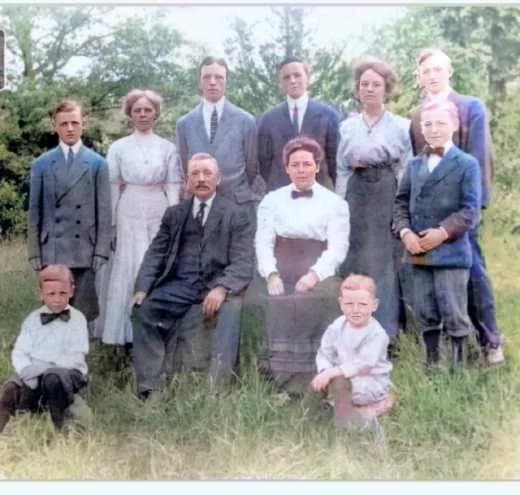
The John Joseph Coogan and Honora Manion family, early 1900s. Honora (seated, center right in white) and John Joseph (seated, center left). Their son Raymond Edward Coogan, who would marry Loretta Pelletier and father Clare, is believed to be among the young men in the back row.
John Joseph Coogan (1861-1929)
Born May 5, 1861, Warwick, Rhode Island (per death certificate, City of Warwick, filed April 11, 1929). not Ireland. John Joseph was first-generation American. His parents. Patrick H. Coogan (PID: LCPF-4D3) and Ellen Conley (variant spelling of Connolly), were the Irish immigrants. The immigration narrative in the Famine Crossing section below references John's grandfather John Coogan and earlier generations, not John Joseph himself.
He died April 10, 1929 at 7 Cora Street, West Warwick, Rhode Island. Cause of death: erysipelas, a bacterial skin infection. Occupation at death: retired(earlier a fireman at a cotton mill, 1910, and a laborer at a velvet mill in Riverpoint, 1920, per the census). Buried at Sts. Peter & Paul Church, Rhode Island.
Source: Return of a Death, City of Warwick, filed April 11, 1929. Informant: Honora Coogan, wife.
John Joseph Coogan & Honora Manion. Their Ten Children
John Joseph Coogan (born May 5, 1861, Warwick, Rhode Island: per death certificate, City of Warwick, filed April 11, 1929) married Honora Manion on October 22, 1885 in Warwick, Kent County, Rhode Island. John Joseph worked as a print worker, and the family lived in River Point, West Warwick / Warwick, Rhode Island from roughly 1870 through 1920. Together they raised ten children:
- Frank Patrick Coogan (1886-1944) · PID: LMWR-HMC
- Mary Theresa Coogan (1888-1927) · PID: 27MR-Q1X
- John Henry Coogan (1889-1969) · PID: 96SX-D55
- Ellen Margaret Coogan (1891-1917) · PID: LD3Y-XM7
- Raymond Edward Coogan (1893-1962) · PID: KLCN-CJL← direct ancestor
- Leo James Coogan (1894-1961) · PID: LD3Y-VKJ
- William Coogan (1896-1897, died in infancy) · PID: LD3Y-KVR
- Vincent Joseph Coogan (1898-1970) · PID: LD3Y-295
- Ambrose Wilfred Coogan (1902-1966) · PID: LD3Y-LR4
- Robert Aloysius Coogan (1906-1994) · PID: LKFT-W5S
Raymond & Loretta’s Family
Raymond Edward Coogan married Loretta Emma Pelletier in 1922 in Rhode Island. They settled at 5 South Beach in Fall River, Massachusetts, where they raised five children:
- Edward Coogan (b. ~1923)
- Helen Coogan
- Joan Coogan
- Pauline Coogan
- Clare Patricia Coogan, married John Joseph Long (Rep. Long). The brothers’ grandmother.
After Loretta’s death in 1951, Raymond married Alice A. Kernin (1894-1961, PID: GGL3-GMR). No children from this marriage.
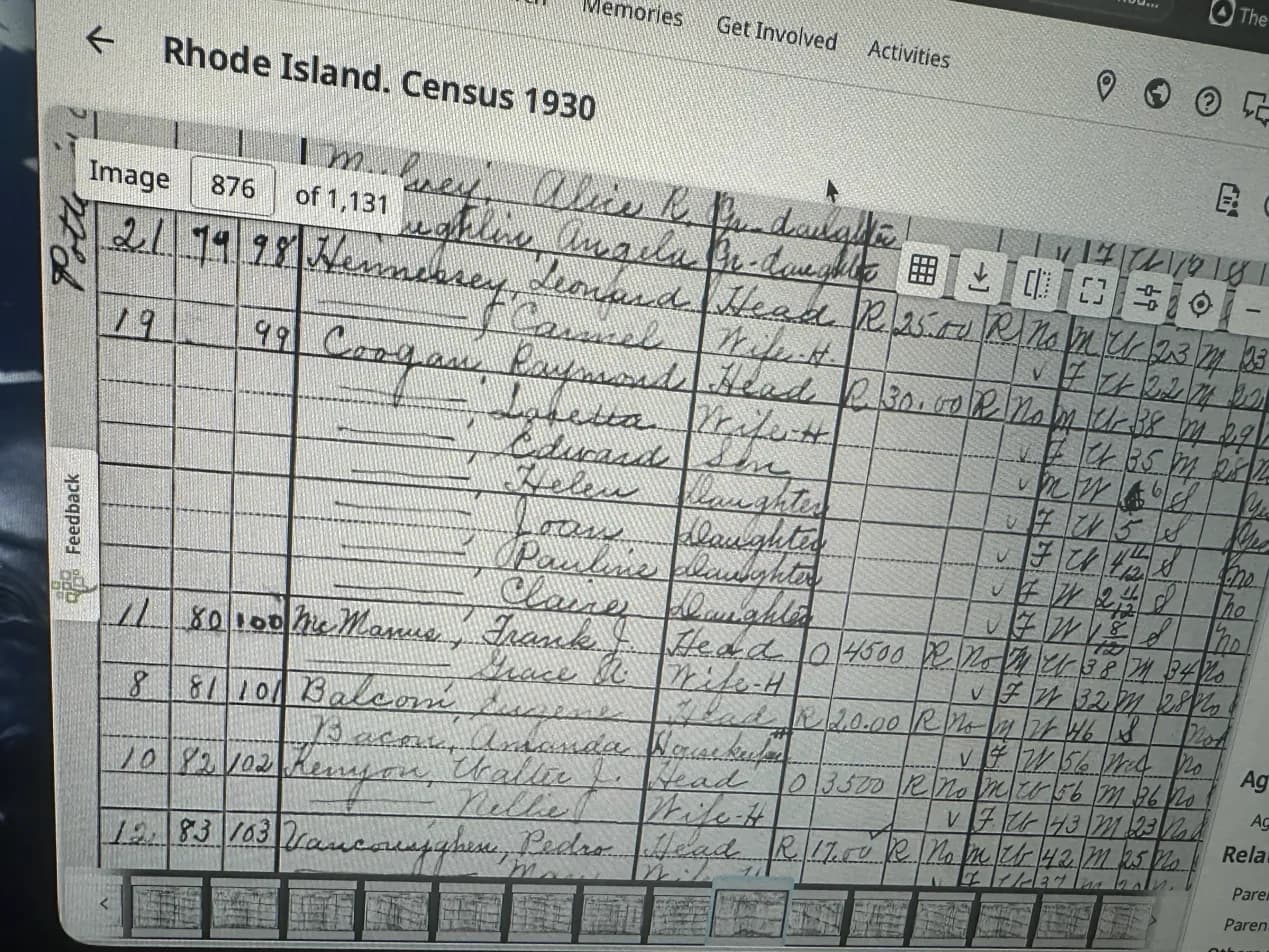
1930 Rhode Island Census. Raymond Coogan household showing Clare as the youngest daughter.
Theory under investigation: Nellie Coogan, reported by a family member via DNA match as a possible stepsister to Raymond Edward Coogan, may be Ellen Margaret Coogan (1891-1917, PID: LD3Y-XM7), Raymond’s older sister. “Nellie” is a common Irish nickname for Ellen. She was born two years before Raymond and died at age 26. No primary sources confirmed.
Confidence: ● Red (speculative). The research status is kept in the archive Basement.
The Ancient Origin: Hounds of War
The Coogan surname (also Cogan, Coggan, Goggin, Keogan) traces to the Gaelic Mac Cogadháin, meaning “son of Cogadhán.” The personal name Cogadhán is a diminutive of Cúchogaidh, which translates to “Hound of War”, a name given to warriors and fighters in ancient Ireland.
The Mac Cogadháin sept originated in the ancient kingdom of Uí Maine (anglicized as “Hy Many”), a Gaelic territory spanning what is today County Galway and County Roscommon in the province of Connacht, on Ireland’s rugged western coast. Uí Maine was one of the great tribal kingdoms of pre-Norman Ireland, governed by its own kings and chieftains for centuries before the English arrived.
The family motto, preserved in heraldry: Non metuo. “I do not fear.”
No coat of arms is historically attested to the Mac Cogadháin sept of Uí Maine. Arms sometimes displayed online under the Coogan surname typically belong to the unrelated Anglo-Norman de Cogan family of Cork, whose male line died out in the 17th century. The absence of recorded arms reflects the Gaelic tradition: Irish septs identified by lineage and territory, not by grants of arms, until the Anglo-Norman period introduced that practice.
A Note on Two Cogan Origins
There are two distinct families who carry the Cogan/Coogan name in Ireland:
- The Gaelic Mac Cogadháin, the native Irish sept from Uí Maine in Connacht. Warriors. “Hounds of War.” This is the line most likely connected to the Fall River Coogans, given the concentration of western Irish surnames (Manion, Carrabine, Kelgallon, Connolly) in the family marriages.
- The Anglo-Norman de Cogan, descended from Milo de Cogan, who arrived in Ireland with Strongbow during the Anglo-Norman invasion of 1169. Milo was Strongbow’s right-hand man and was granted vast lands in County Cork. The first recorded spelling of the Cogan surname anywhere is Milo de Cogan in 1171, in the Records of County Cork. His line died out in the male line by the 17th century, but branches survived under variant spellings.
Whether the Fall River Coogans descend from the Gaelic warriors of Connacht or the Norman knights of Cork, or some convergence of both, remains an open question. The surrounding surnames in the family (Manion, Carrabine, Kelgallon) point strongly to Connacht.
Connacht: Where the Coogans Come From
The province of Connacht , encompassing Counties Galway: Mayo: Roscommon, Sligo, and Leitrim, is the westernmost region of Ireland, bounded by the Atlantic Ocean. It is the most ancient and most Gaelic part of the island, the last region to fall under English control, and the province that suffered most during the Great Famine of 1845-1852.
The landscape is harsh and beautiful: the limestone karst of the Burren, the Cliffs of Moher, the Aran Islands, the bogs and lakes of Connemara. The soil was poor, the farms were small, and the people were tenacious. When the potato blight struck, Connacht was devastated. Entire villages were emptied. Ships left Galway for Boston, New York, and the mill towns of New England.
Every surname in the Coogan family tree points to Connacht:
| Surname | Origin | Gaelic Root |
|---|---|---|
| SurnameCoogan | OriginCounty Galway / Roscommon | Gaelic RootMac Cogadháin. "Hound of War" |
| SurnameManion | OriginCounty Galway | Gaelic RootÓ Mainnín, from the kingdom of Uí Maine |
| SurnameCarrabine | OriginCounty Galway / Mayo | Gaelic RootMac Cairbreáin, western Connacht |
| SurnameKelgallon | OriginCounty Galway / Roscommon | Gaelic RootMac Giolla Cheallaigh, western Irish |
| SurnameConnolly | OriginWidespread, strong in Galway | Gaelic RootÓ Conghaile. "fierce as a wolf" |
| SurnameKeely | OriginCounty Galway | Gaelic RootÓ Cadhla. "graceful" |
This is not a family that scattered across Ireland. This is a family rooted in one place, the stony fields and Atlantic coast of Connacht, who emigrated together and married together in the New World.
While Cromwell devastated Munster, seizing the O’Long lands in Cork, a dozen years after the English Civil War had driven the Coffins from Devon, his policy toward Connacht was equally brutal. His order. “To Hell or to Connacht”, forcibly relocated dispossessed Catholics to the rocky western lands where the Coogans lived. The Mac Cogadháin homeland of Uí Maine absorbed thousands of displaced families, forever changing the demographics of Galway and Roscommon.
See the two 17th-century upheavals that set both sides of the family in motion →
Battles & Historical Events
The Connacht surnames in the Coogan family tree are bound to the most violent chapters of Irish history, the Anglo-Norman invasion that brought the first recorded Cogan to Ireland, the Cromwellian resettlement that drove native families westward into Connacht, and the Battle of Aughrim fought in the heart of Uí Maine itself.
| Date | Event | Family Connection |
|---|---|---|
| Date1169 | EventAnglo-Norman Invasion | Family ConnectionMilo de Cogan arrived in Ireland with Strongbow as his right-hand man. Granted vast lands in County Cork. The first recorded spelling of "Cogan" in Ireland (1171). Source of the alternative Anglo-Norman origin for the Coogan surname, though the Fall River Coogans likely descend from the native Gaelic Mac Cogadháin of Uí Maine, not the Norman de Cogan line. |
| Date1653 | Event"To Hell or to Connacht" | Family ConnectionOliver Cromwell's Act of Settlement ordered all native Irish landowners east of the Shannon to transplant to Connacht or die. Tens of thousands were forced west into Galway, Mayo, and Roscommon. The Coogan and Manion homelands absorbed the displaced, and bore the brunt of poverty for the next two centuries. |
| Date1691 | EventBattle of Aughrim | Family ConnectionThe decisive battle of the Williamite War, fought on July 12 in eastern County Galway, in the heart of the ancient kingdom of Uí Maine. Approximately 7,000 Irish Jacobite soldiers were killed, the bloodiest day in Irish history. The Coogan, Manion, and Connolly ancestors lived within miles of the battlefield. |
The Famine and the Crossing
The Great Famine (An Gorta Mór, 1845-1852) killed approximately one million Irish people and forced another million to emigrate. Connacht was hit hardest: the small tenant farmers of Galway, Mayo, and Roscommon had the greatest dependence on the potato and the least access to alternative food sources.
The Coogan and Manion families likely crossed the Atlantic during or shortly after the Famine years. The exact ship manifests have not yet been located, but the pattern is clear: John Coogan (PID: LD3P-2P9) and Thomas Manion (PID: GVR9-8PX), both born in Ireland, are the earliest documented ancestors. Their children and grandchildren appear in Rhode Island and Fall River records by the 1890s.
The route was almost certainly: Galway or Cobh (Queenstown) → Boston or New York → Rhode Island → Fall River. Irish immigrants followed family and parish networks, settling near people they knew from home. The concentration of Connacht surnames in the Coogan marriages proves they maintained these networks across the ocean.
Fall River: The Mill Town
Fall River, Massachusetts, was one of the great textile manufacturing centers of the 19th century. By the 1870s, the city had more spindles than any other city in America. The mills needed labor, and the Irish provided it.
The Irish arrived in waves, first the Famine refugees of the 1840s-1850s, then the chain migration that followed for decades. They settled in tight-knit neighborhoods organized around Catholic parishes: St. Patrick’s, Notre Dame, Santo Christo, St. Anne’s. They worked the looms, built the churches, ran the unions, and eventually ran the city.
The Coogans came to this story later. From 1880 to 1920 the Coogans and Manions worked in the print works and mills of Warwick and West Warwick, Rhode Island; Raymond Coogan, an assistant manager in an insurance office by 1930, brought his family to Fall River by 1935. On the Long side, the Fall River census records show no one in the mills: Thomas Long was a teamster in 1900, 1910 and 1920.
Source: “United States Census,” 1880 (Patrick Manion, M4SZ-3R5; NARA T9 roll 1209, ED 79, p. 3), 1900 (Patrick Coogan, M972-KPQ; T623 roll 1504, ED 205, sheet 12B), 1910 and 1920 (John J. Coogan, MP6N-Q4Z, MJV8-1DV; T624 roll 1436, ED 26, sheet 15B; T625 roll 1671, ED 35, sheet 10A), 1940 (Raymond Coogan, Fall River Ward 2, K4V2-DXK). Thomas Long: “United States Census,” 1900, 1910 and 1920, Thomas Long household, Fall River Ward 6 (FamilySearch M952-PGT, M2N5-NRP, MXTR-6Q2; NARA T623 roll 636, ED 143, sheet 6A; T624 roll 577, ED 154, sheet 17A; T625 roll 684, ED 77, sheet 11A).
The Connection to the Pelletier Line
Raymond’s marriage to Loretta Emma Pelletier in 1922 united two distinct immigrant traditions: the Irish Coogans and the French-Canadian Pelletiers. Loretta’s family had roots in Quebec going back to the 1600s, with ancestors among the founding families of New France (see: The Pelletier/Harpin Line). This Irish-French-Canadian union was common in the Fall River area, where both communities had settled in large numbers by the late 19th century.
Through Clare Patricia Coogan, these two immigrant streams. Irish and French-Canadian, flow into the Long family.
Active Research
- Irish parish records: John Coogan (PID: LD3P-2P9) and Thomas Manion (PID: GVR9-8PX) represent the current end of the documented chain. Both are believed to have been born in Ireland, likely in Connacht. Irish Catholic parish records from the mid-1800s, available through the National Library of Ireland and IrishGenealogy.ie, may extend these lines further.
- Coogan Research Group: An active online community dedicated to Coogan surname research has documented several branches in Rhode Island and Providence, some tracing to a Peter Coogan of Ireland whose sons settled in Providence in the late 19th century. Whether this Peter connects to the family’s John Coogan is an open question.
- Canadian citizenship: Research conducted April 2026 examined whether the Coogan line might include Canadian-born ancestors. No Canadian connection has been found in the Coogan line. The French-Canadian connection runs through the Pelletier side only.
Bottom Line
The Coogan line is pure Ireland. County Galway, County Meath, the Connacht coast. They came to Rhode Island and Fall River as part of the great Irish wave, married within their community, and built a political legacy that endures today. Through Clare Patricia Coogan’s marriage to John Joseph Long, the Irish Coogans merged with the Irish Longs and the French-Canadian Pelletiers, creating the paternal side of the family documented in this archive.
Every link PID-verified on FamilySearch. Research ongoing.
Additional Verified Ancestors
Surfaced from the archive CSV audit (April 2026).
| Name | Born | PID | Relationship |
|---|---|---|---|
| ●Raymond Edward Coogan | 1893 | KLCN-CJL | Great-grandfather via the Coogan paternal line to John, Perry, and Patrick |