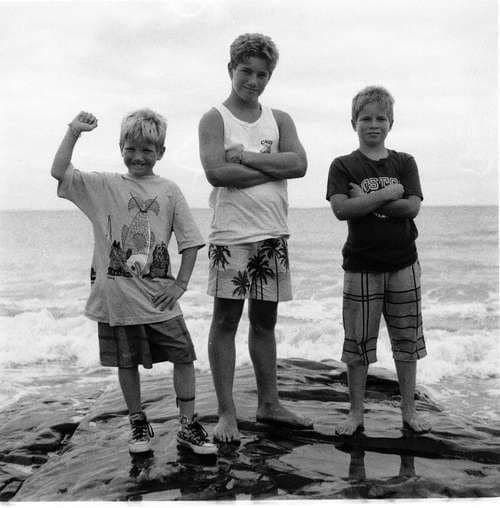
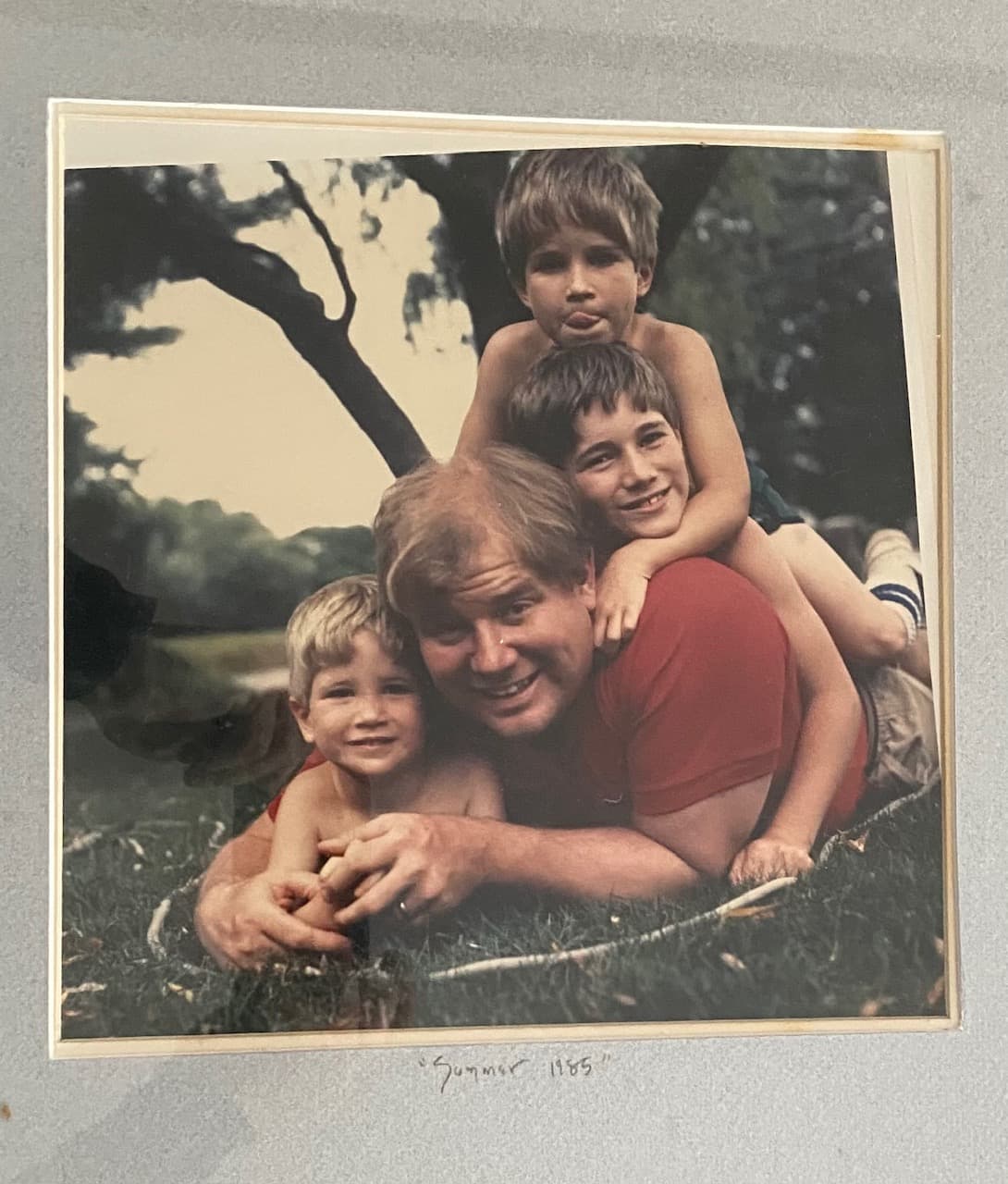
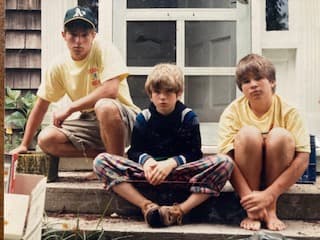
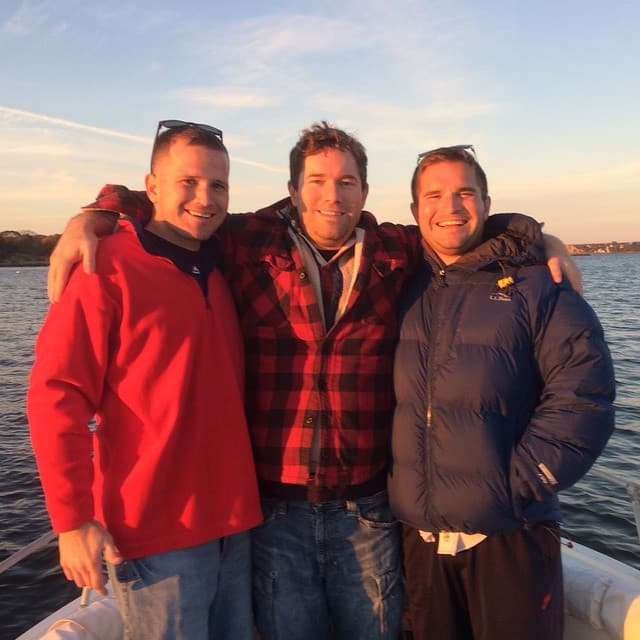
In the 1970s, at the University of Massachusetts Amherst ↗, Carol Perry met John Patrick Long, who grew up in Fall River. John Patrick’s family moved from Fall River to Westport during his high school and college years. Carol’s family had been rooted in Rhode Island and southeastern Massachusetts since the 1650s. John Patrick’s grandparents had arrived from Ireland in the 1890s. They married soon after. Their three sons carry forward twenty-one documented family lines, from the founders of Nantucket in 1659 and four Mayflower passengers of 1620, through Revolutionary soldiers, to the Irish famine refugees of the 1850s and at last to John, Perry, and Patrick Long.
A longer account of the convergence generation. Carol Perry and John Patrick Long, is coming.
The Convergence
One woman, two lines
In 1744, on Nantucket ↗, a woman named Eunice Gardner ↗ (1744-1809, PID LZD4-RLB) was born into two lines that had run separately for nearly a century. Her mother, Jedidah Folger (1711-1757), was the great-granddaughter of Peter Folger (1617-1690), the Nantucket surveyor whose daughter Abiah (1667-1752) became Benjamin Franklin’s (1706-1790) mother. Her father, Robert Gardner (1708-1797), was the son of Hannah Coffin (1686-1768), granddaughter of Tristram Coffin (c. 1605-1681), who had organized the purchase of Nantucket in 1659. In Eunice, the Coffin and Folger lines of the island met.
One woman. Eunice Gardner, carried both lines forward. Nine generations later, her descent reaches three brothers in Massachusetts.
The Shared Inheritance
Held in common
The descent does not belong to any one brother. Whatever the archive documents, the Mayflower passengers, the founders of Nantucket, belongs to John, Perry, and Patrick Long equally and to the same degree. They share one mother and one father; they share, therefore, every line, every cousin, and every generation of depth behind them. A descent earned through any ancestor is a descent all three hold alike.
That documented depth reaches the founding generations of colonial New England, through the Westcott line of Warwick, the founders of Nantucket, and four Mayflower passengers documented in the Mayflower Families genealogies. The broader cousin web, including documented cousinship to Benjamin Franklin and Lucretia Coffin Mott, is set out at Notable Kin.
And it does not stop with them. The family’s five children of the next generation, abstracted here under the archive’s living-persons protocol, inherit the identical descent: the same Mayflower passengers, the same Nantucket founders, the same officer ancestors. The descents are not a portfolio any one person assembled; they are a commons, held by everyone the line passes through and handed on intact.
John Long keeps the archive that this page lives in.
The middle son
Perry Long
Perry Long is a South Coast New Englander through and through, carrying the family name and legacy forward with pride and purpose. He and his wife Carmel are committed to giving back, supporting charitable causes across Massachusetts, Rhode Island, and beyond.
The youngest
Patrick Long
Patrick Long is President and CEO of BayCoast Insurance in Fall River, Massachusetts, where he has been since 2006. He is active in the southeastern Massachusetts business community and in youth sports.
Between them, the three brothers have five grandchildren of Carol Perry and John Patrick Long living today. By the archive’s standing policy, living minors are not named on public pages; full family detail stays in the private vault.
The descent
The ancestors who shaped them
Tristram Coffin
c. 1605-1681 · 10th great-grandfather · founder of Nantucket
Organized the 1659 purchase of Nantucket Island for thirty pounds sterling and two beaver hats, and drafted the share-and-proprietor governance that structured the settlement. First Chief Magistrate of Nantucket (1660-1681). His descent to the brothers runs through his son John Coffin (KNZ2-13G) and John's daughter Hannah Coffin into the Gardner, Macy, and Folger Nantucket marriages.
1645-1717 · 9th great-grand-aunt (sister of John Coffin) · the “Great Woman” of Nantucket
Tristram Coffin’s daughter and the sister of John Coffin (1647-1711, KNZ2-13G), the brothers’ direct maternal ancestor, so a great-aunt of the line, not a cousin. Contemporaries called her the “Great Woman” of Nantucket for her authority over island governance and trade; her 1702 conversion following John Richardson’s visit made her the mother of Nantucket Quakerism, shaping the island’s religious and civic life for a century.
Surveyor and schoolmaster who surveyed Nantucket between 1659 and 1662 and served as interpreter to the Wampanoag. Author of “A Looking Glass for the Times,” a 1676 verse petition on behalf of persecuted Quakers and Baptists. His daughter Abiah Folger was the mother of Benjamin Franklin; his son John Folger carries the direct line into the brothers’ maternal descent.
1667-1752 · 9th great-grand-aunt (sister of John Folger) · mother of Benjamin Franklin
Peter Folger’s daughter and the sister of John Folger (1659-1732), the brothers’ direct maternal ancestor, a great-aunt of the line. Her son was Benjamin Franklin, who appears on this page as a first cousin ten times removed. The two branches meet in the Folger grandparents: the direct line runs through John, the Franklin line through Abiah.
1706-1790 · 1st cousin, 10× removed, via Peter Folger
Franklin’s mother Abiah Folger was born on Nantucket in 1667. Her brother John Folger is the brothers’ direct ancestor; Abiah is Franklin’s mother. The descent is first-cousin at the grandchild level, ten generations removed, verified through the Peter Folger (99BX-1P2) common ancestor.
1723-1798 · 1st cousin, 9× removed, via John Folger · Nantucket merchant
One of colonial Nantucket’s most successful merchants, a woman who ran a trading house in her own name. The brothers’ 1st cousin, 9 times removed, via John Folger (the father of their direct ancestor Jethro Folger); her mother, Abigail Folger, was Jethro’s sister. She sided with the British during the Revolution, her Loyalism named honestly, not led with.
c.1623-1686 · 10th great-grandmother · Quaker dissenter, Rhode Island
Publicly whipped in Weymouth and Boston in the 1650s for preaching Quaker doctrine, an incident documented in contemporary Puritan court records. Among the earliest recorded women to dissent from Massachusetts Bay religious authority; an early member of the Rhode Island community that sheltered similar dissenters.
1592-1677 · 10th great-grandfather · founder of Providence (1638 banishment, one of the thirteen original Proprietors)
One of the thirteen original proprietors of Providence and a co-founder of Warwick on the 1642-43 Shawomet purchase. Banished from the Massachusetts Bay Colony for religious dissent on 12 March 1638, three years after his Salem neighbor Roger Williams. His English origins before Salem are not established by primary documentation.
c. 1576-1625 · 11th great-grandfather · Pilgrim pastor of Leiden
Theological founder of the Pilgrim movement, pastor of the Leiden congregation that became the Mayflower Pilgrims. He died in Leiden in 1625 without ever crossing the Atlantic, but his son Isaac emigrated to Plymouth and Cape Cod, and the line runs into the Swift dynasty and down to the brothers. Without Robinson there is no Pilgrim church and no Mayflower.
1744-1809 · 6th great-grandmother · the Coffin-Folger convergence
The single ancestor where the Coffin line (through her father Robert Gardner, whose mother was Hannah Coffin, Tristram’s granddaughter) and the Folger line (through her mother Jedidah Folger, Peter Folger’s great-granddaughter) converge. Her daughter Margaret “Peggy” Macy carries both lines forward into the Folger surname at Frederick William Folger in 1805.
1927-1989 · Paternal grandfather · MA House of Representatives, 1957-1980
Eleventh, Seventh and Eighth Bristol Districts. Served Fall River in the House when Bristol Community College was founded (1965); an early advocate of the merger that became UMass Dartmouth. Correspondent of John F. and Edward Kennedy, whose letters survive in the family collection; by family recollection, Assistant Majority Leader and a friend of Michael Dukakis. Paternal grandfather to the brothers.
Four Irish surname lines arrived between the Famine emigration and the 1890s: the Longs and Sullivans in Fall River, where Thomas Long worked as a teamster, and the Coogans and Manions in the print works and mills of Warwick, Rhode Island, who came to Fall River in the 1930s. The Coogan line reaches back to the ancient kingdom of Uí Maine in Connacht; the Manions and Sullivans came from Connacht and Munster respectively.
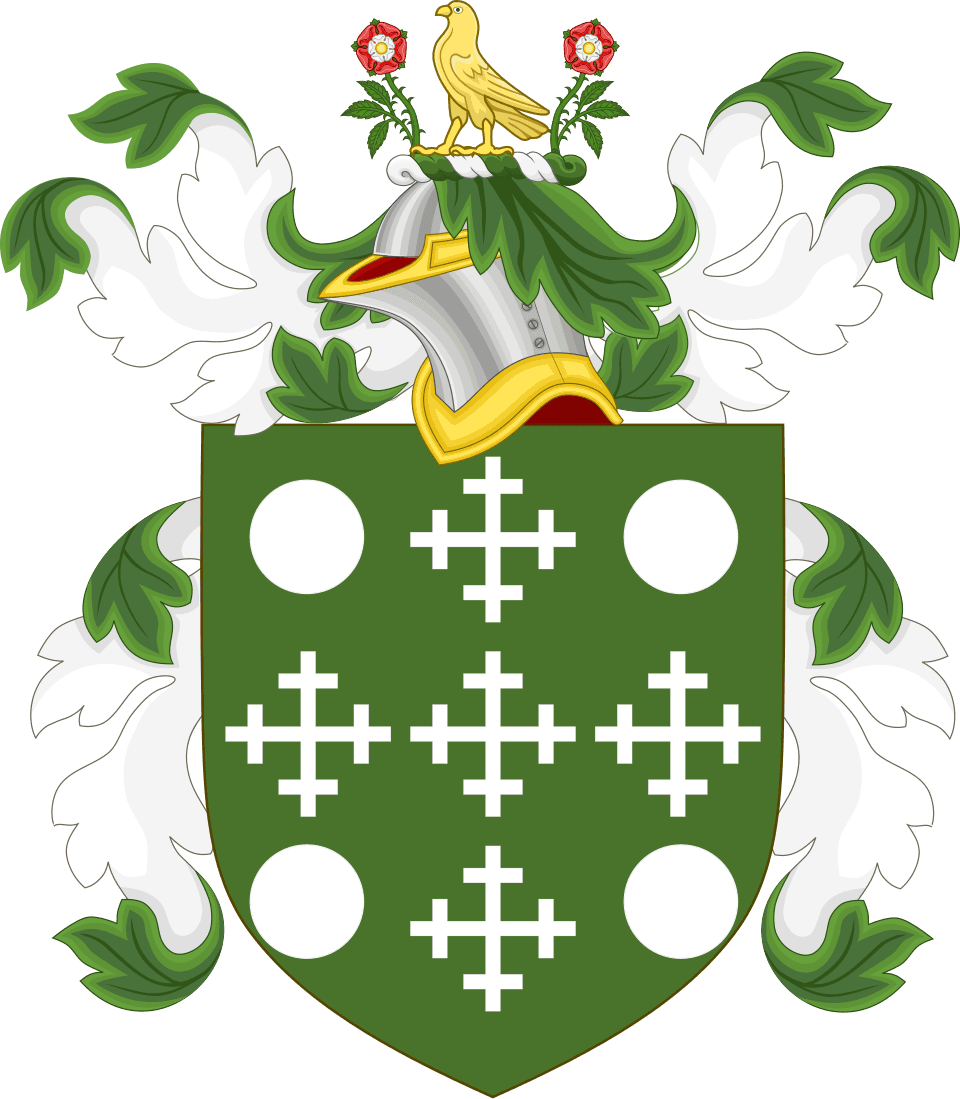
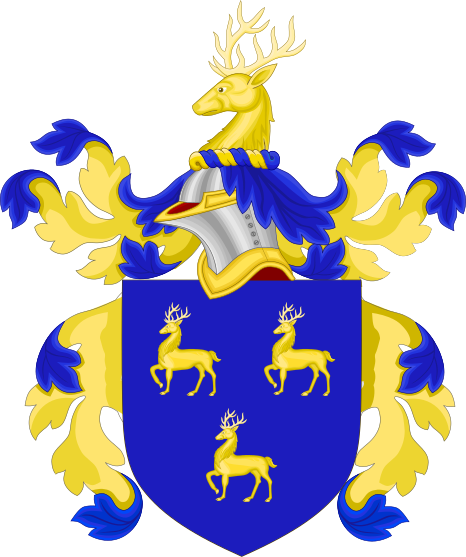
Each documented line has its own heraldic history where one is recorded. Where no shield is yet sourced, the placeholder reserves the space. The archive’s sourcing standard for every shield: original work, CC0, or properly licensed; earliest recorded armiger; source cited.
CoffinCoffin Family
no arms
FolgerNo arms historically attested to this family
no arms
PeckhamKentish Peckham arms do not descend to Rhode Island John Peckham’s line
GreenGreen, per Bolton’s American Armory (1927), attributed to Deputy Gov. John Greene of Rhode Island
no arms
WarrenWarren. Pennsylvania line of Isaac Warren (c. 1812–between 1870 and 1880) and Rachel T. Warren (1843-). No arms historically attested to this branch. Medieval de Warenne arms commonly displayed under “Warren” online belong to an unrelated English noble family; the family’s Warren descent is through a documented Pennsylvania line that does not connect to them.
no arms
GardnerGardner. Dorset branch arms exist (correct for Nantucket Richard Gardner); shield sourcing under review.
no arms
MacyOrigin unknown per Anderson’s Great Migration; no arms recorded
no arms
PerryNo arms attested to Edward Perry’s line; the Bitham 1856 grant post-dates this family by 200 years
no arms
LongIrish Ó Longaigh of Cannaway, no arms recorded; arms displayed under “Long” online typically belong to the unrelated English Long of Wraxall
no arms
CooganNo arms historically attested to the Mac Cogadháin sept of Uí Maine
The arrival. The rest is descent.
This page is the end of the chain. Every documented generation, from medieval Devon to the three brothers in Massachusetts, is cited and linked in the archive itself. The Hastings origin beyond the records is preserved as labeled tradition in the basement.
This page holds the direct line and the closest kin. The wider archive of documented ancestors and cousins, royal, colonial, and reform-era, is catalogued separately in the Notable Kin directory.