Portledge
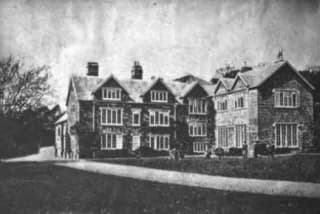
Portledge House, Alwington, Devon, seat of the Coffin family for centuries.
Portledge Manor sits in the parish of Alwington, Devon, England, overlooking the Bristol Channel. The Coffin family held this land, by tradition, from the era of the Norman Conquest; the documented generations begin under Henry II (1154–1189). The name “Coffin” derives from the Norman French, and family tradition places the line’s arrival with William the Conqueror’s forces around the Battle of Hastings in 1066, though the records do not reach the Conquest.
The name appears in the Domesday Book (1086), suggesting some Coffins may have been in England even before the Conquest. By the thirteenth century the name, in its various forms (Colvin, Corvin, Cophen, Coffyn), appears frequently in records across Somerset, Dorset, Wiltshire, and Cornwall.
14 Generations
The documented Coffin generations at Portledge span from the twelfth century to the early 1600s, through the Plantagenets, the Black Death, the Wars of the Roses, the Tudors, and the Elizabethan era, with the Norman origin before that preserved as family tradition. For a detailed treatment of each generation, see the Portledge Centuries family line page.
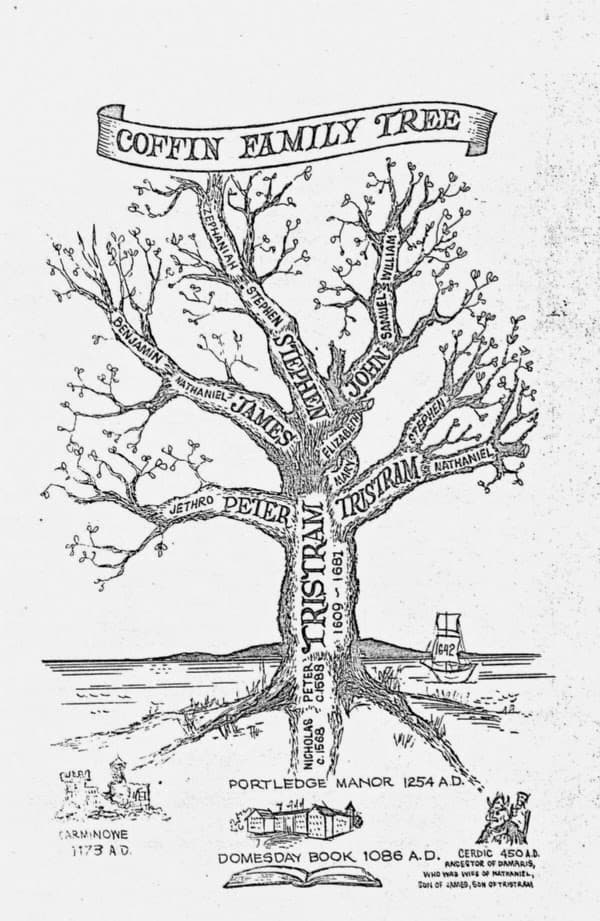
Hand-drawn Coffin family tree illustration.
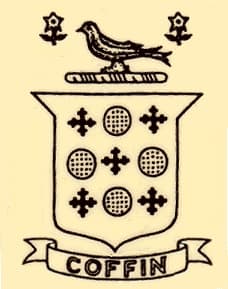
The Coffin family coat of arms.
| GEN | NAME | DATES |
|---|---|---|
| . | ●Sir Richard Coffin | fl. 1066, by tradition |
| 1 | ●Richard Coffyn | b. ~1280 |
| 2 | ●John Coffyn | b. ~1301 |
| 3 | ●David Coffyn | b. ~1332, d. after 1370 |
| 4 | ●David Coffyn | b. ~1361 |
| 5 | ●John Coffyn | b. ~1392, d. 1427 |
| 6 | ●William Coffyn | b. ~1420, d. 1486 |
| 7 | ●Richard Coffyn | b. ~1425 |
| 8 | ●John Coffyn | b. ~1450, d. 1566 |
| 9 | ●Richard Coffyn | b. ~1475, d. 1555 |
| 10 | ●James Coffyn | b. 1514, d. 1566 |
| 11 | ●Peter Coffin | b. 1535, d. 1613 |
| 12 | ●Nicholas Coffin | b. 1560, d. 1613 |
| 13 | ●Peter Coffin | b. 1584, d. 1628 |
| 14 | ●Tristram Coffin | b. 1605, Brixton, d. 1681, Nantucket |
The Coat of Arms
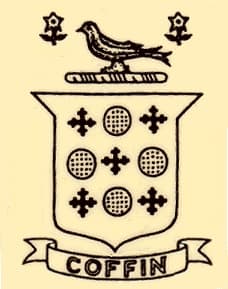
The Coffin coat of arms dates from the family’s centuries at Portledge. The heraldic record reflects the family’s Norman origins and their long tenure as Devon gentry. The arms were borne by the Coffins of Portledge, Alwington, and their cadet branches across southwestern England.
The survival of the arms through the medieval period and into the Tudor era speaks to the family’s continuity, they were not merely landholders but recognized members of the English gentry with a heraldic identity stretching back to the Conquest. Sir William Coffin, kinsman to the Portledge line, served as Sheriff of Devonshire and Master of the Horse for Queen Anne Boleyn’s coronation.
Tristram’s Departure
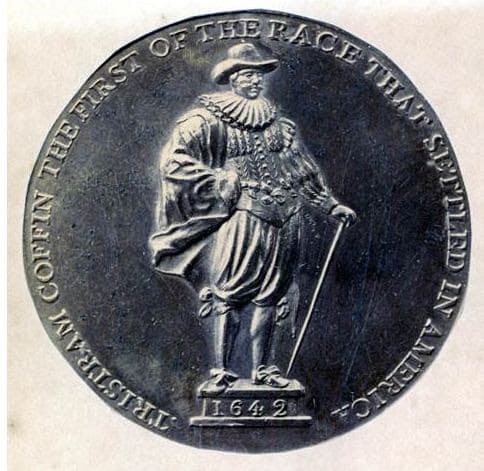
Tristram Coffin (1605-1681). Medallion portrait.
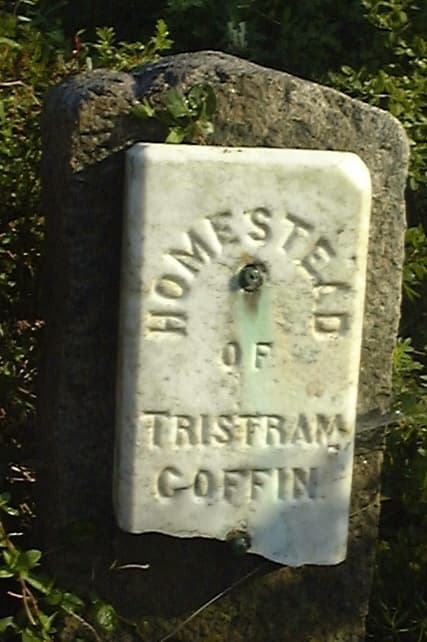
The Tristram Coffin homestead marker, Nantucket.
By the early 1600s, the main Portledge line continued in Devon, but a branch of the family, including Tristram Coffin (born 1605, Brixton), departed for the American colonies around 1642, in the English Civil War, after his brother John was mortally wounded at Plymouth Fort. His father Peter’s will, proved in 1628, had left land to “his son and heir Tristam, who is to be provided for according to his degree and calling.” The senior line kept Portledge and Alwington until 1766; Tristram was of the Brixton branch, a separate line of the family by the 17th century. See audit/07-17th-century-departures.md.
Tristram settled first at Salisbury, Massachusetts, then Haverhill, then Newbury. In 1659, he led the purchase of Nantucket Island with eight other proprietors. He became the island’s chief magistrate, father of seven children, grandfather of seventy-five. “Grandfather of almost all of us,” as Zaccheus Macy later wrote.
The full story of the Nantucket purchase and founding is on the Nantucket Founding history page.
Portledge Today
Portledge House still stands in Alwington, Devon. It is now a private estate. The building visible today dates primarily from later centuries but occupies the same site the Coffin family held for over 500 years.
The family’s Norman estate in France, at Courtition near Falaise, twenty miles south of Caen, remained in Coffin hands until 1796, giving the family a continuous presence on both sides of the English Channel for seven centuries.
Research Confidence
1066 origin. Sir Richard Coffin at Hastings
Based on published Coffin family genealogies and heraldic records, not independently verified primary sources. The connection from Sir Richard (1066) to Richard Coffyn (~1280) is traditional, not generation-by-generation documented.
Medieval generations (~1280-1628)
Based on published genealogies (Parkman, Barney Genealogical Record) with better documentation in later generations. Parish records, wills, and marriage records provide increasing confidence as we approach the 1500s.
Tristram Coffin forward
Well-documented through FamilySearch, Nantucket Historical Association records, and multiple published sources. Tristram’s emigration, Nantucket purchase, and descendants are established historical fact.