Part VII · Chapter 1
The Domesday Book & the Coffin Name
Tristram Coffin, the Long brothers' 10th great-grandfather
1086 · Alwington, Devon
People in this chapter
- Tristram Coffin (c. 1605–1681)the Long brothers' 10th great-grandfather
At Christmas 1085 William the Conqueror ordered a survey of landholding across England, carried out in 1086. [1][2] The Coffin name does not appear in it. [3] This chapter is the history of the name and of the Coffins of Alwington, in Devon, as the records give it.
What Is the Domesday Book?
The Domesday Book is the oldest surviving public record in England [2] and one of the most remarkable documents in Western history. Commissioned by William the Conqueror at Christmas 1085, it was a complete survey of landholding in England, who owned what, how much it was worth, and what resources it held. [1] The survey was carried out in 1086 and written up over the following years; it records some 13,000 settlements across England. [2]
The name “Domesday” (meaning “Day of Judgment”) reflected the finality of its records: like the Last Judgment, there was no appeal. [4] If the Domesday Book said a man owned a piece of land, he owned it. If it said he didn’t, he was out of luck. The survey was both an administrative tool and a statement of absolute royal authority over the conquered English landscape.
The Norman Conquest and Alwington
On October 14, 1066, William, Duke of Normandy, defeated King Harold II at the Battle of Hastings. [5] The Norman Conquest that followed was one of the most transformative events in English history. Within twenty years William had replaced almost the whole of the Anglo-Saxon landholding aristocracy with Norman lords and their followers; [6] at Alwington the English lord of 1066, Ordwulf, had given way by 1086 to Hamelin, holding under Robert, Count of Mortain. [7] The greatest of the new landholders were William’s allies, some of them men who had fought beside him. [8]
Nineteenth-century writers on the Coffins repeated a tradition that a Sir Richard Coffin came with William at Hastings and was granted the Manor of Alwington. [9][10] The Coffins’ own 1881 historian could not document it. [11] The Domesday Book of 1086 records Alwington as held by Hamelin under Robert, Count of Mortain (not by a Coffin), [7] and the standard published pedigree (Vivian’s Visitations of Devon) carries the Coffins of Alwington back only to a Richard Coffin in the reign of Henry II (1154-1189), with no Hastings companion. [12] Their documented presence at Portledge begins in the 13th century, with a royal grant of free warren at Alwington to Richard Coffin in 1254; [13][14] they held the estate until it was sold in 1998. [14]
What the Record Shows
The tradition also held that the Coffins were recorded in the Domesday survey, within twenty years of the Conquest. [9] The 1086 entry for Alwington does not bear this out: the lord of Alwington in 1086 was Hamelin, holding under Robert, Count of Mortain. [7] No Coffin appears anywhere in the survey’s index of landholders. [3] Only about fifteen of the men who fought beside William at Hastings can be named with certainty, and the Coffin is not among them; [8] the “came over with the Conqueror” Battle Abbey Roll survives only in late, corrupt copies of a surname list of little evidential weight. [15]
What is documented is still unusually deep. The Coffins held Portledge in the parish of Alwington from the medieval period; the house is a medieval building whose hall and a rear doorway keep twelfth-century work, [16] and the line is set out in Vivian’s Visitations of the County of Devon back to a Richard Coffin in the reign of Henry II (1154-1189). [12] Counting from the first dated Portledge deed of 1254, that is a documented Devon tenure of more than seven centuries down to the estate’s sale in 1998, [13][14] but even the pedigree begins in the century after the Conquest, not on the battlefield at Hastings.
The name also travelled. Tristram Coffin, of Brixton near Plymouth, sailed for New England in 1642, [17] and his descendants carried the name to Nantucket, the whaling industry and abolitionism. [18] No record links the Brixton Coffins to the Coffins of Alwington, [11] and the archive does not claim the link.
The Coffin Coat of Arms
The Coffin of Portledge arms are blazoned: Azure, semé of crosses crosslet, three bezants Or. [10] In plain language: a blue field strewn with small gold crosses, with three gold coins (bezants). Because the crosses are strewn rather than counted, drawings differ; Vivian’s printed shield shows nine, [12] and the drawing below shows eight. Later heraldry books assigned meanings to colours and charges (blue for loyalty and truth, bezants for coin and Byzantine gold, crosses for faith), but heraldic authorities reject such readings as evidence of what arms meant to their bearers. [19] The arms are no evidence of crusading service or Norman origin: Burke records them from the heralds’ visitation of Devon of 1620, centuries after the Conquest. [10]
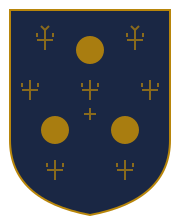
The Coffin coat of arms: Azure, semé of crosses crosslet, three bezants Or
The history of Portledge and the Coffins of Alwington is told on The Portledge Centuries.
Read more: The Coffin Dynasty · Nantucket & the Whaling Era
Sources
- J. Ingram, trans., The Saxon Chronicle, with an English Translation (London: Longman, Hurst, Rees, Orme, and Brown, 1823), 288–89, s.a. 1085. archive.org
- The National Archives, “Domesday,” accessed October 16, 2026. nationalarchives.gov.uk
- Anna Powell-Smith, Open Domesday, “All names” index (data from J. J. N. Palmer, University of Hull). opendomesday.org
- Richard FitzNigel, Dialogus de Scaccario, bk. 1, ch. 16, in Ernest F. Henderson, trans., Select Historical Documents of the Middle Ages (London: G. Bell and Sons, 1912), 76–77. archive.org
- J. Ingram, trans., The Saxon Chronicle, with an English Translation (London: Longman, Hurst, Rees, Orme, and Brown, 1823), 264, s.a. 1066. archive.org
- Stephen Baxter and C. P. Lewis, “Domesday Book and the Transformation of English Landed Society, 1066–86,” Anglo-Saxon England 46 (2017): 343–403. doi
- Caroline Thorn and Frank Thorn, eds., Domesday Book 9: Devon (Chichester: Phillimore, 1985), 15,8; Open Domesday, “Alwington.” opendomesday.org
- G. E. Cokayne, The Complete Peerage, new ed., vol. 12, pt. 1, ed. Geoffrey H. White (London: St Catherine Press, 1953), app. L, “Companions of the Conqueror,” 47–48.
- Allen Coffin, The Coffin Family (Nantucket: Hussey & Robinson, 1881), 6–7. archive.org
- Sir Bernard Burke, The General Armory of England, Scotland, Ireland, and Wales (London: Harrison & Sons, 1884), 210. archive.org
- Allen Coffin, The Coffin Family (Nantucket: Hussey & Robinson, 1881), 16. archive.org
- J. L. Vivian, ed., The Visitations of the County of Devon (Exeter: H. S. Eland, 1895), 208–11, “Coffin of Porthledge.” HathiTrust
- Allen Coffin, The Coffin Family (Nantucket: Hussey & Robinson, 1881), 8–9. archive.org
- Friends of the National Libraries, “Archives of the Pine-Coffin Family of Portledge,” grant record (acquired 2010). fnl.org.uk
- Duchess of Cleveland, The Battle Abbey Roll, with Some Account of the Norman Lineages, vol. 1 (London: John Murray, 1889), vi–vii. archive.org
- Historic England, “Portledge Hotel,” Grade II*, list entry 1170778. historicengland.org.uk
- Allen Coffin, The Coffin Family (Nantucket: Hussey & Robinson, 1881), 19–20. archive.org
- Anna Davis Hallowell, James and Lucretia Mott: Life and Letters (Boston: Houghton, Mifflin, 1884), 18–19. archive.org
- A. C. Fox-Davies, A Complete Guide to Heraldry (London: T. C. & E. C. Jack, 1929), 5. archive.org